Technology Associates Engineering Experts
Technology Associates
Expertise Contact us
History
Areas of Expertise
Services Expertise Qualifications Highlights Articles
Areas of Expertise
Airbags
Animation
Biomechanics
Computer Simulation
Construction
Doors
Electric Fire
Electric Shock
Falls
Forklift
Golf Carts
Guarding
Human Factors
Ladders
Motorcycles
Occupant Injury
Parking Lots
Pedestrians And Bikes
Pools
Power Saws
Product Liability
Premises Liability
Retail Stores
Rollovers
Seatbelts
Sports Playground
Standards
Structures
Trucks
Vehicles
Visibility
Warnings
Whiplash
Slopes
Geofoam
Blasting
Retaining Walls
Structure Cracking
Collapse
Faulty Construction

Technology Associates
Forensic Engineering Experts - Ph (800) 358-9909 - Fax (888) 358-9901
BIOMECHANICS
Biomechanics is the application of mechanics to the interaction of biological systems with their external environment. When investigating an accident, biomechanical analysis can be used to reconstruct a victim’s motion and relate it to his injuries. This can be applied in such diverse cases as determining the post-impact motion of occupants involved in an automobile accident, or calculating the impact force of an elevator door closing on a person’s knee. A biomechanical analysis may be accomplished with simplified “stick figure” models or complex 3D computer simulation techniques. Biomechanics

Expertise

Questions Answered
We have extensive experience in many aspects of biomechanics including:
  • Head-form/windshield impact testing
  • Head (HIC) and other Injury Criteria
  • Computer simulations
  • Body size & reach analysis
  • Extensive Biomechanical Library
Through scientific analysis, we can help you answer pertinent questions such as:
  • Could the accident have happened the way the Plaintiff describes?
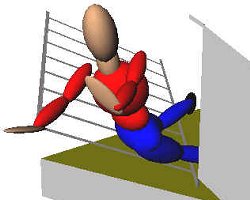
  • Did the victim trip into the railing or was she pushed hard?
  • What level of injury could be expected from such an impact?

Past Case Examples
Fall from Swing: Fall Over Balcony Railing:

   A child was swinging on a plastic swing seat when he fell off and suffered a severe head injury. The defense claimed that he must have been standing or otherwise misusing the swing when the accident occurred. We used a biomechanical simulation to demonstrate that the low coefficient of friction (COF) between the swing seat and the child’s shorts could have resulted in the fall he described and that an alternate seat design with a higher COF would have prevented the accident.

   A woman was injured when she struck a balcony railing which gave way, allowing her to fall to the ground 10 feet below. She claimed she was walking at a normal speed when she tripped and fell into the railing. Our biomechanical analysis of the impact and fall based on the balcony height and her rest position, determined that she was moving much faster than a normal walking speed when she struck the railing. This result supported evidence that she was pushed, and helped the case settle rapidly.

Home | Services | Expertise | Qualifications | Highlights | Articles